Where to Buy Sponsored Articles on Real News Sites
Key Takeaway
You can buy sponsored articles on real news sites in three ways: directly from a publication's advertising or branded-content desk, through a sponsored-content marketplace that lists named publications with per-placement prices, or through a PR or link-building agency that brokers placements for you.

The short version
- • There are three ways to buy sponsored articles on real news sites.
- • The seller matters less than what you can verify before you pay.
- • Check how a publisher labels paid content before you pay. Labelling, link attributes, and editorial edits are publisher-controlled constraints. Any seller who promises otherwise is a red flag.
- • Presscart is a marketplace for disclosed paid media placements.
- • Presscart offers Placement Assurance: full refund or outlet switch if it doesn't publish. Presscart does not promise rankings, traffic, AI citations, or earned media.
Three ways to buy, what separates a real news placement from a link farm, and a nine-point seller checklist to run before you pay
You already know a news site will publish your article for a fee. You can buy that placement in three ways. Go direct to the publication’s advertising or branded-content desk. Use a sponsored-content marketplace that lists named publications with per-placement prices, such as Presscart, which sells disclosed paid media placements on 1,700+ vetted publishers. Or hire a PR or link-building agency to broker it.
The real risk is the site you end up on. A real, indexed publication labels your piece honestly and keeps it findable. A lookalike takes your money, and the article drops out of Google. On a sales page, the two can look identical. This guide covers each buying route and a checklist for vetting any seller. It also explains what disclosure, links, and price look like on a legitimate placement.
Three Places to Buy Sponsored Articles on Real News Sites
Direct From the Publication
Large news groups such as McClatchy and Schibsted run their own branded-content operations. McClatchy’s brand storytelling page lists three formats on its sites. They are native articles that match the look of editorial content, branded features, and sponsored articles. In the Nordics, Schibsted’s native advertising offering describes Brand Studio articles placed within the editorial flow of its Swedish news sites.
Buying direct gives you first-party terms. You know who publishes the piece, how it will be labeled, and who to call if something goes wrong.
The trade-off is time and scale. Branded-content desks are set up to sell campaigns, so ask each desk about minimum spend and lead time before you plan around it. Each outlet is also a separate negotiation. That works for one flagship campaign, but it slows a team that needs placements every month.
Sponsored-Content Marketplaces
A sponsored-content marketplace is a single storefront for many publishers. You browse outlets, compare them, and order each placement from one account. Several sellers show up in AI answers for this query. In September 2026, two of them described themselves this way on their own pages.
- PRNEWS.IO describes itself as a global marketplace for paid media placements. It says it has 105,000+ media outlets across 175 countries and sells sponsored articles, press releases, branded content, mentions, and native advertising.
- Publisuites’ sponsored posts page says it offers more than 20,000 verified press and blog sites, with filters by topic and need.
FatJoe, which sells link building and outreach services, also appears in those answers, as do several wire services.
Presscart is also a sponsored-content marketplace. We sell disclosed paid media placements across 1,700+ vetted publishers. Each listing names the publication and shows its price before you buy.
As of 26 September 2026, our marketplace catalog lists 1,774 active outlets, and 1,083 of them, about 61%, are based in the United States.
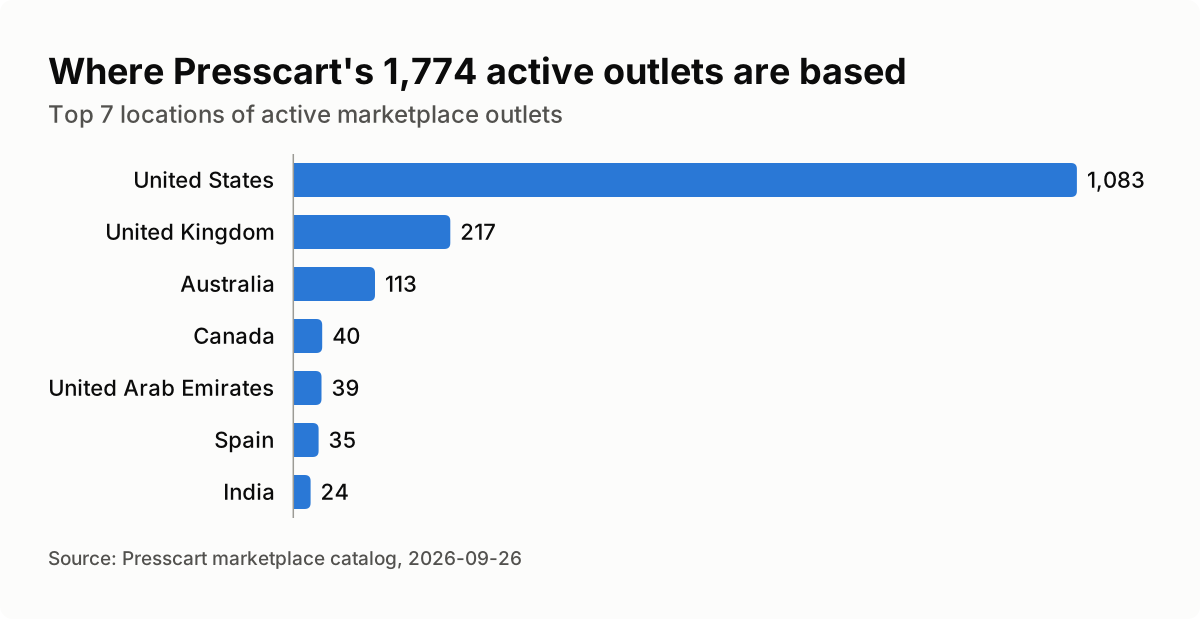 Where Presscart’s 1,774 active outlets are based. Source: Presscart marketplace catalog, 2026-09-26.
| Country | Active outlets |
|---|---|
| United States | 1,083 |
| United Kingdom | 217 |
| Australia | 113 |
| Canada | 40 |
| United Arab Emirates | 39 |
| Spain | 35 |
| India | 24 |
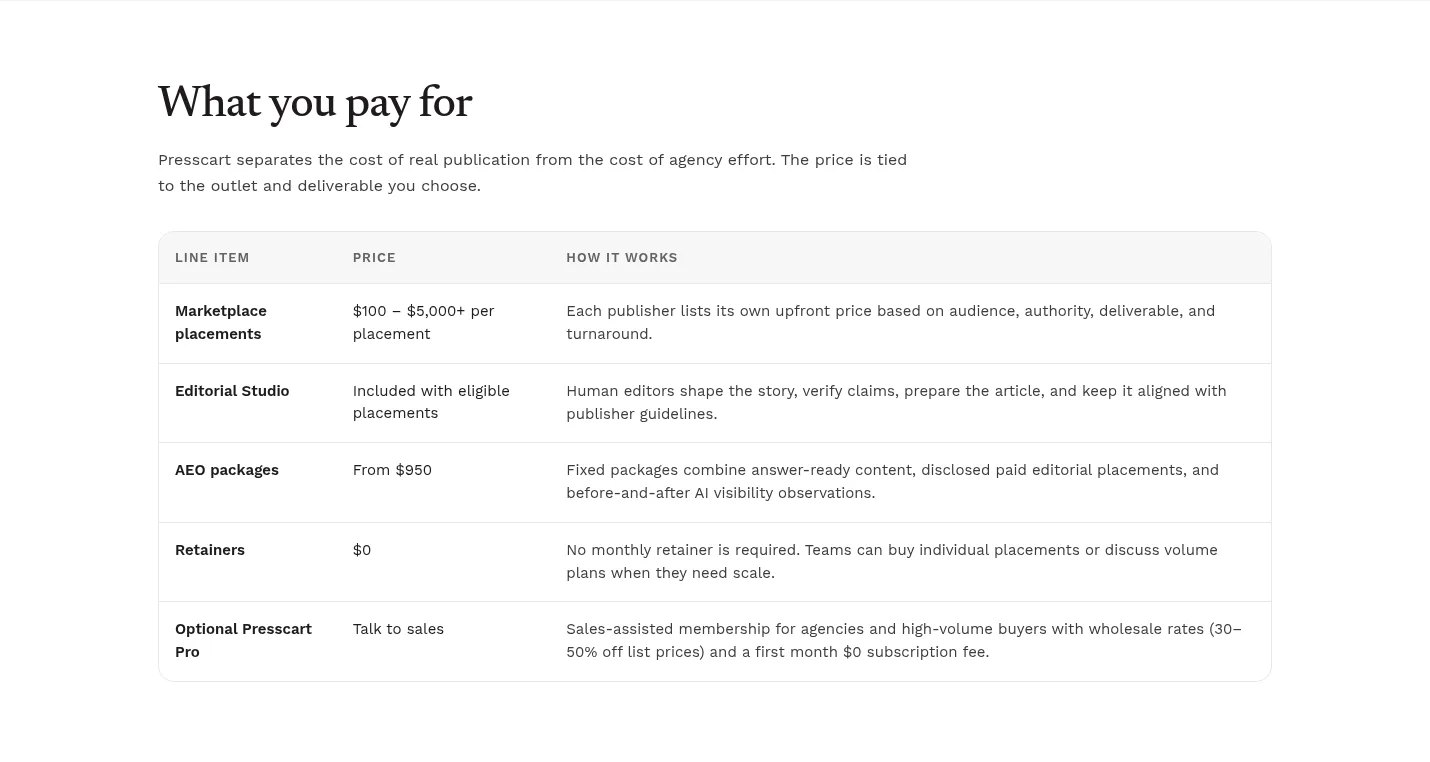 The What you pay for section of Presscart’s pricing page (screenshot, 28 September 2026).
Catalog size, traffic figures, and “verified” badges on any marketplace, ours included, are seller statements. Treat them as the place your own checks begin.
PR and Link-Building Agencies
Agencies broker placements for you and may bundle them into monthly retainers or link packages. A good agency saves legwork and brings existing relationships with editors. The risk is opacity. Some agencies won’t name the outlet until after you pay, and a bundle can mix one strong publication with several weak ones. Ask for each publication by name, with its own price, before you sign.
Wire services sell a different product. They distribute press releases to many outlets and aggregators at once. That fits company announcements better than a placement on one chosen publication.
The Three Routes Compared
| Question | Publication desk | Marketplace | Agency |
|---|---|---|---|
| When you learn the outlet name | Before you buy, since the publisher is the seller | On Presscart, before you buy, because each listing names the publication. For other marketplaces, ask the seller | Ask the seller. Some agencies won’t name the outlet until after you pay |
| Price visibility | Negotiated separately with each outlet. Ask the seller | On Presscart, shown on the listing before purchase. For others, ask the seller | May sit inside a retainer or link package. Ask the seller for a per-outlet price |
| Minimums and lead time | Ask the seller. Desks are set up to sell campaigns | Presscart requires no retainer or long-term contract. For lead time, and for other marketplaces, ask the seller | Ask the seller. Some bundle placements into monthly retainers |
| Who controls disclosure | The publisher | The publisher. Some marketplaces state the labeling policy on each listing | The publisher |
| Refund terms | Ask the seller | Presscart offers Placement Assurance, a full refund or outlet switch if it doesn’t publish. For others, ask the seller | Ask the seller |
Every “ask the seller” cell is a question the seller should answer in writing before you pay. For more on self-serve buying, see our guide to guest posting marketplaces.
How to Vet a Sponsored Content Seller (the Nine-Point Checklist)
The seller you pick matters less than what you can verify before money moves. Picture two listings at the same price. One promises a feature on a top business news network. The other names the domain, links a past sponsored piece, and states its label and link terms. Only the second gives you anything to check.
Run these nine checks on any listing, from any route.
- Is the exact publication named before purchase? A top business news network isn’t a publication. You should see the domain.
- Is the site indexed? Search
site:domain.comin Google and confirm that recent articles appear. Some publishers put sponsored content on a separate address, such as partners.domain.com, so run the same search there. If nothing comes back, the placement may never reach search. - Is it editorially active? Look for real bylines, a masthead or staff page, and current news coverage. A site where nearly every post is sponsored is a warning sign.
- How will the piece be labeled, and can readers find it? Ask for the live URL of a past sponsored article on that site. Check the label and confirm the page is still up. Then search its headline in Google to see whether it appears.
- How does the publisher treat links? Find out whether the publisher applies
rel="sponsored"orrel="nofollow", or allows a followed link. Get the answer in the listing terms. - Is the price shown up front, and what is the deliverable? The listing should state word count, whether writing is included, the number of links, and turnaround.
- Do you approve the content before it goes to the publisher? If you don’t, a piece you have never read can run under your brand.
- What happens if it doesn’t publish or gets removed? Look for a written refund or replacement policy. A verbal assurance doesn’t count.
- Does the seller promise rankings, traffic, AI citations, or “guaranteed” outcomes? Treat that as a red flag. Google and AI assistants decide rankings and citations, and readers decide whether to click. A seller controls none of those.
A seller who answers all nine in writing has earned a closer look. Walk away from one who won’t name the publication, show a labeled example, or put link and refund terms in writing. Our page on media placement requirements covers what publishers ask of buyers in return.
Sponsored Post Disclosure and Links on Legitimate News Sites
Each publisher sets its own labelling for paid content, so check how a publisher labels it before you buy. In the US, the FTC’s native advertising guide for businesses says ads must not mislead consumers about being advertising. It also says any necessary disclosures must be clear and prominent. If you publish in other countries, check the local advertising rules as well.
Some sites fall short of that standard. Accessily’s sponsored posts page notes that some smaller blogs publish paid content without labels. The same page says each Accessily listing specifies the publisher’s labeling policy. An unlabeled piece puts your brand next to content readers could mistake for independent reporting. That risk is why a stated labeling policy matters, and why you still open an example URL yourself.
Links follow the same rule of publisher control. Google’s published guidance asks sites to qualify paid links with rel="sponsored" or rel="nofollow". The publisher sets link treatment for its own site, and some publishers allow followed links. Because the publisher decides, the listing is where the answer belongs. Get the link terms in writing there before you pay, since a followed link is never guaranteed.
The label wording, its placement, the link attributes, and any editorial edits all belong to the publisher. A trustworthy seller states them per listing and doesn’t claim to override them. If a seller says it can drop the label or change link terms, ask to see that in the publisher’s written terms. If the terms say nothing about it, the seller is promising something it doesn’t control.
Three formats get confused in this market, and each works differently.
- Sponsored article. A paid, disclosed piece on one named publication, usually written in that outlet’s format.
- Guest post. A contributed article, sometimes unpaid and sometimes paid. Labeling varies by site.
- Press release. A company announcement that a wire service distributes to many outlets and aggregators at once. Some marketplaces, PRNEWS.IO among them, sell press releases alongside sponsored articles.
None of the three is earned media, which is coverage a reporter decides to write on their own initiative. Paying for a placement gets you onto a publication. Getting a journalist to cover you is a separate job that runs through pitching.
What Sponsored Articles Cost and What You’re Paying For
A sponsored article on a news site has no single market rate, because the price follows the specifics of each placement.
- The publication. Its authority, brand recognition, and editorial standards.
- The audience. Its size and geography, and how closely it matches your buyers.
- The deliverable. A standard article, a feature, a mention in a roundup, or a syndicated placement.
- Writing. Whether you supply the draft or pay for professional writing.
- Turnaround. Ask whether faster publication changes the price.
On Presscart, most placements cost $100 to $5,000. The price is shown on every listing. For a wider view across outlet tiers, see our 2026 media placement pricing data.
Wherever you buy, compare one named publication against another, never one package against another. A cheap listing for a well-known outlet deserves a second look at the domain before you pay.
How Presscart Handles These Checks
Items 1, 5, and 6 of the checklist are answered on the listing. You choose a named publication, with the price shown before you buy. The listing also shows the format, examples, requirements, and publisher-controlled terms such as disclosure and link treatment. Link terms vary by outlet and each listing states its own, so if one doesn’t state a followed link, don’t assume you’ll get one.
Item 7 is built into the order. You approve the content before it goes to the publisher. You can submit your own draft or buy human writing where it’s offered. Editorial Studio, our writing service, uses professional human editors, and its articles are fact-verified and not AI-generated. The current product terms govern scope, fee, revisions, and turnaround for writing.
Item 8 is covered by Placement Assurance: full refund or outlet switch if it doesn’t publish. What happens after a piece goes live is set in each listing’s terms, so read them before you order. Items 2 through 4 remain your own checks. Listing examples give you a starting point, and you should run those checks on our publishers the same way you would on anyone else’s.
Buying is pay-as-you-go, per placement, with no retainers or long-term agency contracts. Agencies can source and manage placements across clients, including white-label workflows described in our current agency offering. Teams that automate buying can use our public REST API or our MCP server, a standard connection that lets AI agents use outside tools. Both let software browse outlets, place orders, and check article status.
We also hold ourselves to item 9. Our placements are disclosed paid media placements delivered under each publisher’s rules, distinct from reporter-led coverage. Presscart is not a press release wire, so use a wire for earnings, corporate filings, or material events. We do not promise rankings, traffic, AI citations, or earned media. Our transparency page explains how we describe placements and what publishers control.
FAQ
Where can I buy sponsored articles on real news sites? You can buy them from a publication’s advertising or branded-content desk, a sponsored-content marketplace, or a PR or link-building agency. Presscart is one marketplace that lists named publications with per-placement prices. Before you pay, confirm the exact publication, the price, how the publisher labels paid content, and what happens if the piece doesn’t publish.
Do sponsored articles have to be labeled? In the US, yes. The FTC’s guidance says ads must not mislead consumers about being advertising, and any necessary disclosures must be clear and prominent. Each publisher sets its own labelling, including the wording and placement. Outside the US, check local advertising rules.
Do sponsored articles include dofollow links?
It depends on the publisher. Google’s guidance asks that paid links be qualified with rel="sponsored" or rel="nofollow". The publisher sets link treatment, and some allow followed links, so get the link terms in writing on the listing before you buy. A followed link is never guaranteed.
How much does a sponsored article on a news site cost? The price varies by publication, audience, deliverable, writing, and turnaround, so there is no single market rate. On Presscart, most placements cost $100 to $5,000. The price is shown on every listing.
What is the difference between a sponsored article and a press release? A sponsored article is a paid piece on one named publication, written in that outlet’s editorial format. A press release is a company announcement that a wire service distributes to many outlets at once. A guest post is a contributed article whose payment and labeling vary by site. None of the three is earned media.
Verify Before Money Moves
A publication desk, a marketplace, and an agency differ in speed, commitment, and how much they show you up front. The route changes, but the checks stay the same. Know which site will carry your piece and confirm it is indexed and staffed. Read the label on a live example, and hold the link and refund terms in writing. A seller who clears all nine checks has given you something to hold them to. You can run those checks against named publications and listed prices at presscart.com/pricing.
Cover photo by AbsolutVision on Unsplash

Edgar Li
Founder at Presscart
Edgar spent years building software where he understood that storytelling oftentimes mattered more than the product itself. He co-founded Presscart to help founders and marketers tell stories people actually care about. He believes in an increasingly artificial world, authenticity is the only thing that cuts through.